The Perception
Box
How to plan, produce, and host a Perception Box evening. Built to travel: any venue, any city, any capacity.
Words in double braces, like {{ PARTNER ORGANIZATION }} or {{ MONTH YEAR }}, are blanks on purpose, for your organization to fill in with its own name, dates, rooms, and times. Every {{ }} across the playbook works the same way.
Edition: {{ MONTH YEAR }}
Evening format by The Recording Club
Start here
One method. Infinite rooms.
This playbook holds two things at once: the exact evening The Recording Club runs each month, and a kit of parts you can rebuild to fit your space, your team, and your city. Read it front to back once. Then take what serves your room and leave the rest.
The heart of the night, the Perception Box circle, never changes. It is the reason everyone is here. Everything around it, the movement, the heat, the meal, the music, is a module: bring it in, size it up or down, or leave it out entirely. A night with only a circle of chairs, a facilitator, and honest questions is a complete Perception Box. Everything else deepens it.
Throughout, you will see gold-underlined fields like {{ your detail }}. Those are yours to fill in. Where a choice depends on your room or your crowd, an Adapt note tells you how to scale it.
How to read this book
Two companion pages go with this book: a library of every question we use, and a look at the app we run the night on.
What is the Perception Box?
Every one of us moves through the world inside an invisible box, built from our beliefs, our experiences, our values, and our wounds. It quietly filters everything we see. Unlikely Collaborators, the nonprofit founded by Elizabeth R. Koch, gave that box a name so we can begin to notice its walls.
The premise is simple and demanding: most of the conflict we meet on the outside begins as unresolved conflict on the inside. When a person recognizes their own box, even for a moment, the walls loosen. Curiosity returns. Difficult feelings become bearable. We meet each other with more room.
The Recording Club exists to make that moment happen in good company. We wrap the method in an evening of movement, warmth, stillness, and a shared meal, so that by the time the questions come, the room is soft enough to answer them honestly.
Open every event by naming the Perception Box out loud. Partners are welcome to use Unlikely Collaborators' language and framing. Keep the method and its credit intact; change only the room around it.
Five principles that hold the night together
Times and amenities change from room to room. These do not.
The box is the point
Sauna, food, and music draw people in, but they are never the reason. Set every intention around the Perception Box so guests arrive knowing the real event is coming, and stay for it.
Body first, then stillness
The arc moves from doing to being: greet, move, sweat and cold, breathe, eat, then sit. A regulated body tells the truth more easily than a restless one.
Ritual over novelty
Same night each month, same shape, same welcome. Consistency is what turns an event into a practice people return to.
Comfort is production
Covered surfaces, candles, low light, warm towels. People open up in a space that has obviously been cared for. Treat hospitality as part of the method.
Design the flow, then flex it
Hold a run-of-show, and hold it loosely. Double a session for a big crowd, cut one for an intimate room. The order matters more than the clock.
The modules of a Perception Box night
Eight building blocks, in the order guests move through them. Keep the required ones. Scale the rest to your venue and capacity.
Welcome & Intention Tour
Greet every guest at the door. Once a good group has gathered, about fifteen minutes before the first session, gather everyone: name the Perception Box, set the intention for the night, and walk them through the space so they know where each part happens.
Post the schedule at the entrance so latecomers can be pointed straight to what is next.
Movement
A group workout opens the body and breaks the ice. The format flexes to whatever you can lead well: strength, mobility, breath-led movement, or a simple guided stretch.
Swap a full workout for a ten-minute guided stretch or a walk. The goal is a body that has moved, not a hard session.
Contrast Therapy
Guided heat and cold: warm the sauna before doors, then coach guests through the plunge, breathing them through the shock. Have a host on hand for anyone who needs support.
No sauna or plunge? Replace with a breathwork round or a warm-and-cool sequence guests can feel in their own bodies. The point is a shared physiological reset.
Guided Meditation
A guide leads the room down into stillness, often over live piano. Run it inside in your quietest room, or outdoors on cushions and mats if the weather and space allow.
The Communal Meal
Food lands right as guests come out of meditation, already laid out and waiting. Our reference plate is simple and repeatable: a vegetable, a carb, and two proteins. Lay it out as a self-serve spread, or have your chef plate each guest when numbers are tight.
Keep the four-part balance and adjust the dishes to what is local, seasonal, and inclusive of your guests' diets. Plate individually when supply is limited so everyone is fed.
The Perception Box Circle
The room sits together, mats or chairs in a grid, and moves through five to six questions curated before the event. Each question gets seven to ten minutes. Two microphones pass hand to hand so voices carry across the room. This is what the whole night has been preparing everyone for.
Questions come from the Question Library, tailored to your group and set against the night's intention in advance. Front of house gets the list, and it goes on the wall or is printed and handed out. Each station across the night can carry its own themed prompt, so the questions feel woven through the evening, not sprung at the end.
Sound Bath
Guests stay in the same spot they held for the circle. A short intro, roughly ten minutes, then thirty minutes of sound. Close with a brief breakdown: what people saw, what they felt, questions from the floor.
Reflection & Wrap-Up
The host closes with a warm seven-to-ten-minute wrap-up, thanking everyone by name where they can. Doors close within about fifteen minutes as guests are gently walked out.
The event run of show
How the night unfolds for your guests. This is the reference timeline for a standard night: copy it, then shift the clock to your room. The order is the recipe; the times are yours. For the crew's version, staff call to final lock-up, see the next chapter.
| Time | What happens |
|---|---|
| 5:00 PM | Doors open. Sauna on, lounge and sauna opening, welcome at the door begins. |
| ~5:45 PM | Welcome & tour. Set the intention, name the Perception Box, walk the space. |
| 6:00 PM | Movement. First workout session (double it for a big crowd). |
| 6:30 PM | Contrast therapy. Guided cold plunge and sauna. |
| 7:00-7:30 | Guided meditation. Inside or outdoors, often with live piano. |
| 7:30-8:00 | Communal meal. Laid out and waiting as guests come out of meditation. |
| 8:00-8:45 | The Perception Box circle. Five to six questions, two roaming mics. The heart of the night. |
| 9:00-9:30 | Sound bath. Ten-minute intro, thirty minutes of sound. |
| 9:30-9:40 | Reflection. What people saw and felt, questions from the floor. |
| 9:40-9:50 | Wrap-up. Host thanks the room and closes. |
| ~10:00 PM | Doors close. Guests walked out, breakdown begins. |
For a large group, schedule two of a module, two circles, two meditations, or two sound baths, so no single session is overcrowded. For an intimate night, collapse the amenities and give the circle more room to breathe. Keep the body-to-stillness order intact.
The staff run of show
The production version, down to every detail: who does what, from the crew's arrival, through the event, to the final clean. Call time is doors minus three to four hours. The clock below assumes a 5:00 PM doors, our standard, so slide the whole sheet to whatever hour you open.
| Time | Crew | The job |
|---|---|---|
| Setup Staff call to doors, about 3 to 4 hours out | ||
| 1:00 PM | Manager | Kickoff and check-in. Confirm every off-site staffer and practitioner: arrival times and what each is bringing. Assign the day's zones. |
| 1:30 PM | Crew | Deep clean and surfaces. Cover all surfaces. Clean the movement area and turf to the workout planned. Clean the shower room and set towels (five a side on plunge nights, three on a normal night). Stock bathrooms, place candles. |
| 2:00 PM | Crew | Amenities. Check the sauna oil. Set the cold plunge to temperature. Sweep and set the outdoor lounge. Check the propane in the heaters. |
| 2:30 PM | AV | Atmosphere. Low-frequency or 44Hz music on. Soothing visuals on the LED wall and lobby TV. Dim the main room to blue and neutral tones. |
| 3:00 PM | AV | Sound and capture. Set cameras if filming, about two hours out. Place speakers, one to the guests and one to the guide, patch the keyboard and mixer, line-check the two vocal mics and the room mics. Load the wall: Unlikely Collaborators logo on entry, questions queued. |
| 3:30 PM | Crew | Kitchen and mats. Prep the kitchen for the chef's arrival. Bring cushions and yoga mats down from storage and stage them for meditation. |
| 4:00 PM | Guide | Practitioner load-in. Meditation guide and sound practitioner arrive; give them setup time and confirm the music path, piano inside or outside. Post the schedule at the entrance. |
| 4:30 PM | All | Run-of-show meeting. The whole team walks the entire night together. Assign the two mic runners. Confirm the questions are in front of house's hands. |
| Showtime Doors to close | ||
| 5:00 PM | Host FOH | Doors open. Sauna on. Greet at the door; point guests to sign-ups and where each thing happens. |
| ~5:45 | Host | Welcome and tour. Gather the room, name the Perception Box, set the intention, walk the space. FOH catches latecomers at the posted schedule. |
| 6:00 | Coach | Movement. Run the workout, two back to back for a big crowd. Crew resets towels and water. |
| 6:30 | Guide Host | Contrast therapy. Coach breathing through the plunge; a host on hand to assist. Crew replenishes towels. |
| 7:00 | Guide AV | Guided meditation. Guide leads; AV holds the levels, room speaker and guide monitor; keep it dim and quiet. Crew: right before dinner, bring the mats inside and lay the grid. |
| 7:30 | Chef FOH | Communal meal. Chef lays out or plates; FOH keeps the line moving. Questions and intentions on display around the room. |
| 8:00 | Host Crew | The Perception Box circle. The facilitator runs five to six questions, seven to ten minutes each; two runners pass the mics through the crowd; AV captures. Crew quietly starts putting food away. |
| 8:45 | Guide | Sound bath intro. About ten minutes. Guests hold the spot they took for the circle. |
| 9:00 | Guide AV | Sound bath. Thirty minutes. Room mics capture; lights held low. |
| 9:30 | Guide | Reflection. Lead the feedback: what people saw and felt. Mic runners on hand. |
| 9:40 | Host | Wrap-up. Thank the room and close. FOH preps the exit. |
| ~10:00 | All | Doors close within fifteen minutes of the last question. |
| Breakdown & cleanup After the last question | ||
| 10:00 | FOH | Send-off. Walk every guest out warmly. |
| 10:05 | Crew | Mats. Gather, sanitize, and return them to storage. |
| 10:15 | Crew | Surfaces. Sanitize, wipe down, and uncover. |
| 10:20 | Crew | Outdoor. Break down the lounge, cushions away, sauna off, cover and secure the plunge, heaters off and propane secured. |
| 10:25 | Chef | Kitchen. Finish putting food away, most is done during the circle and bath, then dishes and trash. |
| 10:35 | AV | Equipment, last. Power down and pack the speakers, mixer, mics, and cameras; wind the cords. |
| 10:35 | Guide | Instruments. The meditation guide and sound practitioner pack their own gear; give them room, they are particular about it. |
| 10:50 | All | Final reset. Sweep and clean, lights up, lock up. |
At an intimate capacity, one person wears several hats: the host runs front of house, a guide handles sound. Set call time to doors minus three to four hours and scale the setup to the amenities you actually have. Drop any row that names a part you are not running.
The planning countdown
The Recording Club runs this once a month on a fixed date. Here is the path from picking a day to closing the doors.
Lock the day, keep it consistent
Pick a repeating slot and protect it. Our standard is {{ a Wednesday, once a month }} with doors at {{ 5:00 PM }}, but any day and time works. Lock it into your internal calendar so the whole team builds around one fixed point.
Confirm your practitioners
- Meditation guide (and their music setup)
- Sound bath practitioner
- Chef or caterer, confirm the menu (vegetable, carb, two proteins)
- Movement coach, if you are running one
When the whole team confirms the date and timeframe, the night is real.
Create the event listing
Duplicate last month's event on your invite platform (we use {{ Partiful }}). Keep the flyer text and description the same, change the flyer's background color and the date, and set the host, plus a co-host if you like.
Invite in rounds
Blast your network about a week ahead, in waves sized to your list:
- Round one: {{ 300 to 400 }} people
- Round two: {{ 200 to 300 }} people
- Day before: everyone remaining on your list
Prep, then hold the run-of-show
Staff arrive three to four hours early to prep the facility (Chapter 06). The manager on duty checks in with any off-site staff to confirm everyone is coming. Before doors, gather the whole team and walk the entire run-of-show together.
Your team and their roles
The full roster below. At a smaller capacity, one person can wear several hats, a host who also runs front of house, a guide who also handles sound.
Host
The face of the evening. Greets guests, sets the intention, leads the tour, and closes with the wrap-up.
Event Manager
Owns the run-of-show, checks in with staff, keeps every module on time, and solves problems quietly.
Meditation Guide
Guides the meditation, often with live music. Particular about their own gear; give them setup time.
Sound Practitioner
Runs the intro, the sound bath, and the reflection. Handles and packs their own instruments.
Chef / Caterer
Arrives one to two hours early, preps the kitchen, lays out or plates the meal, and manages portions.
Front of House
Welcomes and directs guests, points them to what is next, and shares the Perception Box questions.
AV / Tech
Sets speakers, mics, cameras, lighting, and the wall visuals. Captures the night if you are recording.
Setup & Breakdown Crew
Preps surfaces and amenities before, resets and cleans after. Often the same hands as the rest of the team.
The space
Guests open up in a room that has obviously been cared for. Staff arrive three to four hours early to build the feeling before the first guest arrives.
Atmosphere
Cover all surfaces so the space reads clean and considered. Play something soothing and low, we use low-frequency or 44Hz sound, and put calm visuals on any screens. Candles in the bathrooms. For the circle and sound bath, dim the lights to blue and neutral tones and keep the room somewhat dark, so people feel held and relaxed.
The amenity areas
Clean the movement area and shower room, and set out extra towels, five a side on plunge nights versus three on a normal one. Turn the sauna on before doors, around 5:00 PM, since it is the first thing most guests reach for. Check the sauna oil, the plunge temperature, and the propane in any outdoor heaters. If you are meditating outside, bring down cushions and yoga mats and build a lounge.
The circle
Bring the mats in from outside right before the meal and lay them in a grid. Most guests settle into the spot they take for the circle and stay there through the sound bath, so set the grid with both in mind.
If you have an LED wall or screen, show the Unlikely Collaborators logo as guests enter, then the questions during the circle. No wall? Print the questions and hand them out at the door. Both work beautifully.
The technical setup
Scale the rig to what you own. A full night wants a proper audio path; an intimate one can run on almost nothing.
The complete rig
One speaker facing the guests, a second facing the guide. A keyboard for live music. A small mixer, two channels up to twelve, running stereo out to the speakers. Two vocal mics, wireless or wired, for the circle. A couple of room mics to capture the sound bath and the voices in the circle. Cameras set up about two hours before if you are filming.
Enough to carry the room
One capable speaker and a phone or laptop source. A single handheld mic passed for the circle. Live music optional. Warm, even, present, that is all the circle truly needs.
Voices only
No PA at all is a valid choice for a small room. Sit close, speak plainly, let people project. Print the questions so no one strains to follow.
Lighting and visuals
Dim to blue and neutral tones for the circle and bath. On the wall: the Unlikely Collaborators logo on arrival, the questions during the circle. Keep it dark enough to feel private.
None of this is precious. The circle has run with two wireless mics and with none at all. Choose the lightest setup that still lets every voice reach every ear.
Curating the Perception Box questions
The questions are the night. Start with the Question Library, draw the ones that fit, then shape them for the people in your room.
Open the Question Library first. It holds all 139 questions we draw from, sortable by intensity and subject, with the sets we have run and a picker that builds your list. Read through it and pull five to six questions that fit your intention.
Browse by intensityGentleDeepWorkshop
Then make them yours. Reword a question so it sounds like your group, or swap one for a question your room needs more. Give each one seven to ten minutes, pass two microphones through the room so answers travel, and hand the final list to front of house before doors. You do not need brand-new questions every month; you need the right questions, set against a clear intention.
Theme the night. Let each station across the evening carry a prompt that points toward the same intention, so by the time guests reach the circle, the questions feel like a thread that has been running all night, not a surprise at the end.
When you rewrite or add a question, keep it in the spirit of Unlikely Collaborators' Perception Box framework: questions that help people notice their own box rather than defend it. When in doubt, ask what softens a wall.
Question worksheet
Tonight's intention
{{ what is this night about? }}
The questions
1. {{ opening, gentle }}
2. {{ notice a belief }}
3. {{ where it came from }}
4. {{ its cost }}
5. {{ what expands }}
6. {{ closing, forward }}
Scaling by capacity
The same night at three sizes. Find the column closest to your room and build from it.
| Intimate10 to 30 guests | Standard30 to 60 guests | Large60 to 100 guests | |
|---|---|---|---|
| Invites | A personal list, one round | Two rounds, then day-before | Rounds of 300-400, then 200-300, then the rest |
| Sessions | One of each module | One of each, roomy timing | Double the circle, meditation, or sound bath |
| The meal | Plated per guest | Self-serve spread | Plated or stationed to control portions |
| Team | Combined roles, 2 to 4 people | Full roster, single of each | Full roster plus extra front of house and crew |
| Audio | One mic, or none | Two mics, small mixer | Full rig, room mics, two-speaker path |
| Amenities | Optional, or a breath reset | As available | Staggered so lines never build |
Customize the app
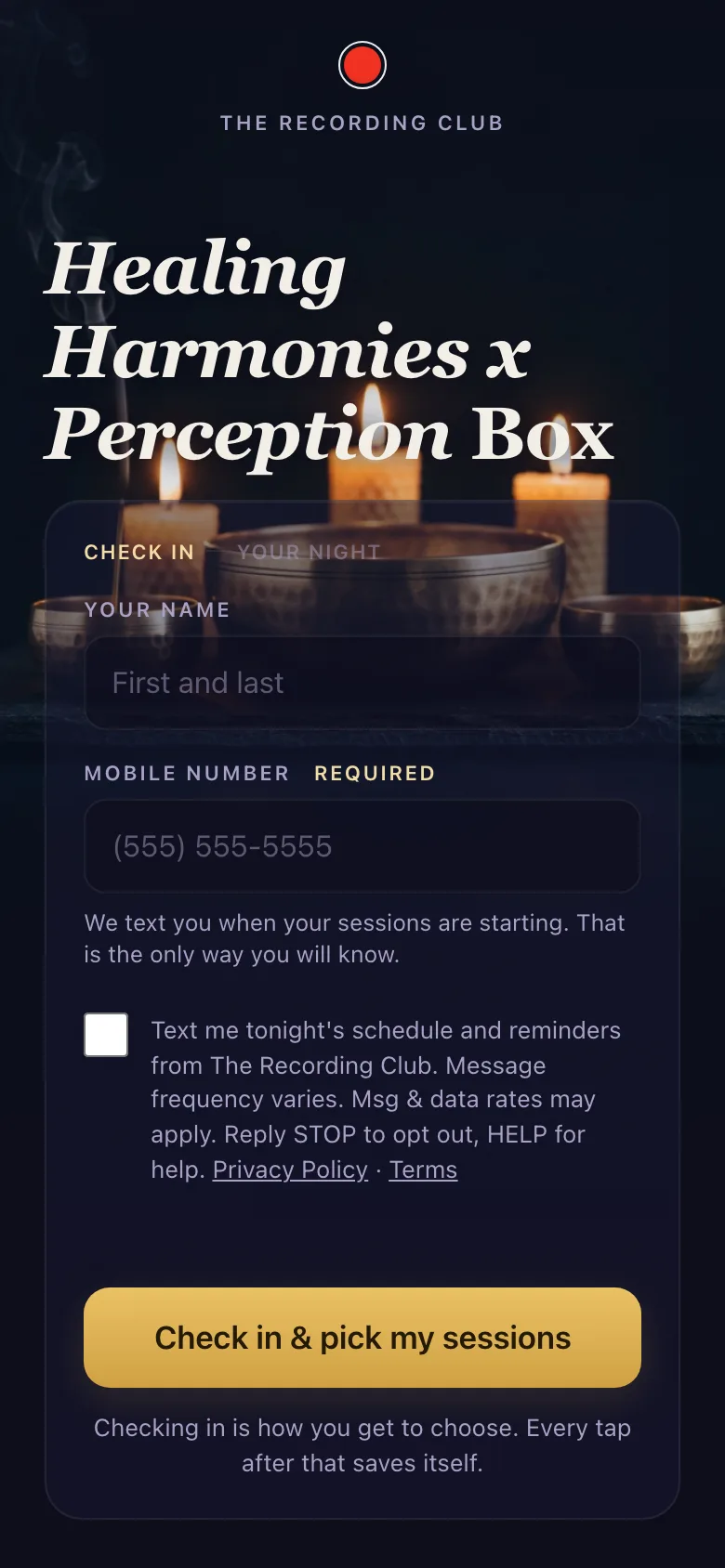
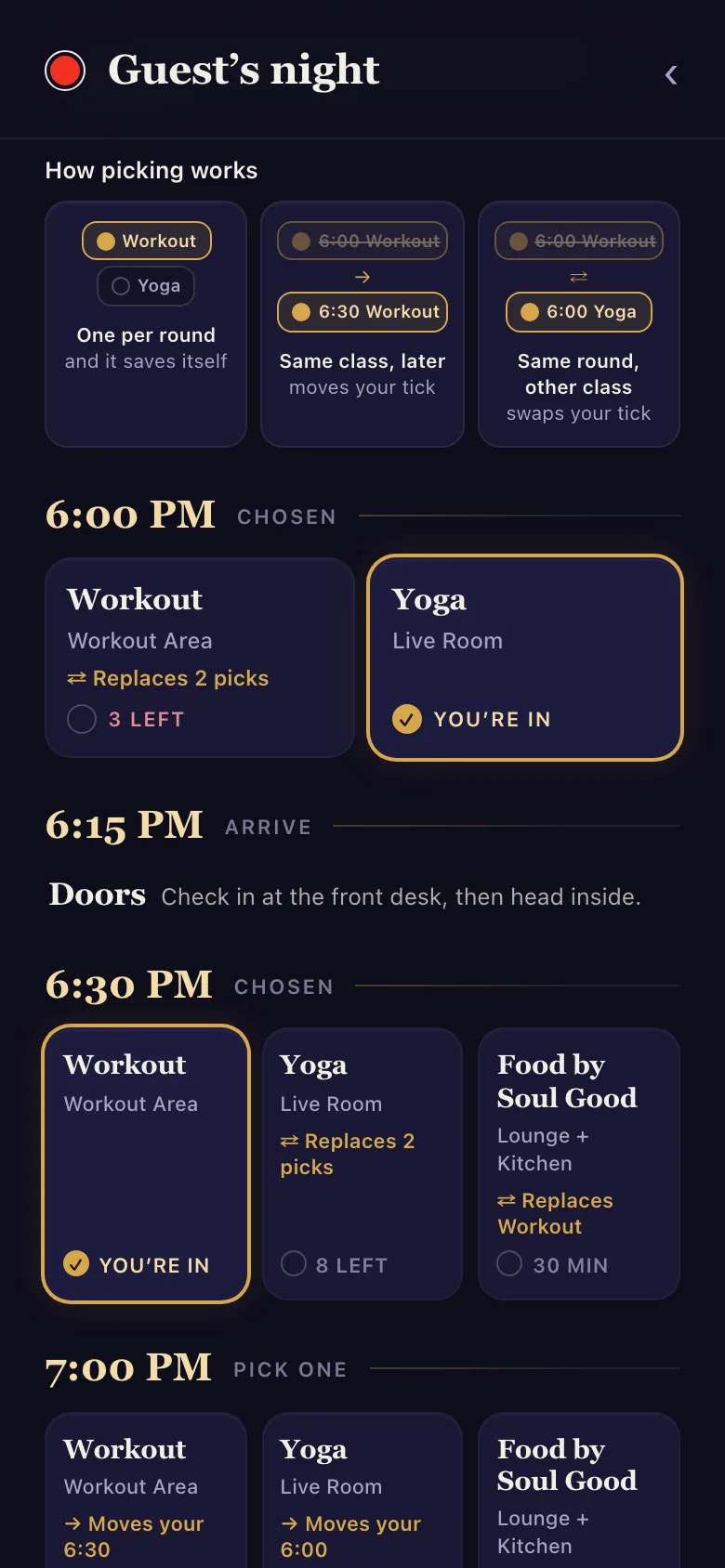
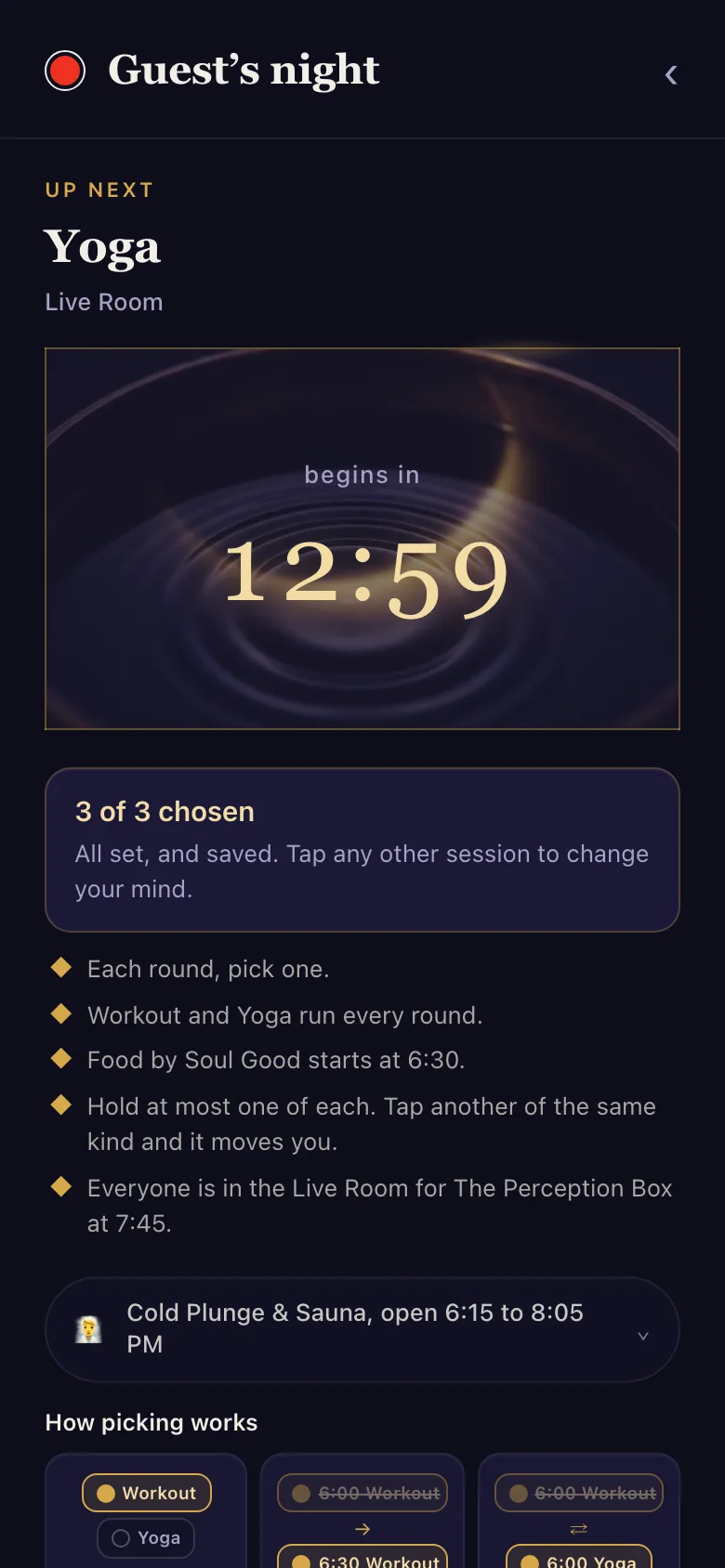
The Recording Club runs every Perception Box Night on its own app. The same system can be set up for your organization, with your logo, colors, rooms, and schedule.
- Guests check in at the door and pick their sessions
- A text five minutes before each session
- A lobby screen and an LED wall that show the questions
- A shared crew checklist and a survey after the night
Printable checklists
The whole playbook, boiled down to boxes you can tick.
Weeks before
- Lock the date and time on the calendar
- Confirm meditation guide
- Confirm sound practitioner
- Confirm chef and menu
- Confirm movement coach (if any)
- Build and duplicate the event listing
- Set host and co-host
The invite waves
- Round one blast (about a week out)
- Round two blast
- Day-before blast to the rest
Design the circle
- Set the night's intention
- Curate five to six questions from the Question Library
- Theme the stations to the intention
- Hand the final list to front of house
- Load the wall, or print copies
Day of, 3 to 4 hours before
- Cover all surfaces
- Low-frequency music on
- Calm visuals on screens, candles in bathrooms
- Clean movement and shower areas
- Towels set (five a side on plunge nights)
- Sauna on by 5:00 PM, oil checked
- Plunge temperature set
- Propane and heaters checked
- Cushions and mats staged
- Kitchen prepped for the chef
- Check in with off-site staff
- Walk the full run-of-show as a team
Audio and vision
- Speakers placed and tested
- Keyboard and mixer patched
- Vocal mics ready (two for the circle)
- Room mics for capture (if recording)
- Cameras set, about two hours before
- Lights dimmed to blue and neutral
- Wall visual loaded (logo, then questions)
After the last question
- Walk guests out warmly
- Mats back and stored
- Surfaces sanitized
- Outdoor area broken down
- Food put away
- Equipment broken down last
- Guides pack their own instruments
- Final clean
In partnership
A method, and the room built around it.
Unlikely Collaborators is a nonprofit founded by Elizabeth R. Koch. It exists to help people resolve conflict by noticing and working with their Perception Box. The framework and its language belong to them; this playbook uses them with care.
The Recording Club hosts the Perception Box as a monthly evening of movement, warmth, stillness, and shared reflection, and built this playbook so any partner can host their own, anywhere in the world.
Prepared by The Recording Club in partnership with Unlikely Collaborators for {{ PARTNER ORGANIZATION }}.
Contact: {{ your contact }} | Edition {{ month year }} | Customize this playbook
The Perception Box™ framework is the work of Unlikely Collaborators. This document describes The Recording Club's hosting format and is intended for approved partners producing the event. Questions about the format: info@therecording.club.